
Trade laser cutting means we cut your parts on our fiber laser while the design and the customer stay with you. Sign companies, manufacturers and designers send us their files; we cut stainless steel, mild steel, galvanised steel and aluminium and deliver clean, burr-free parts.
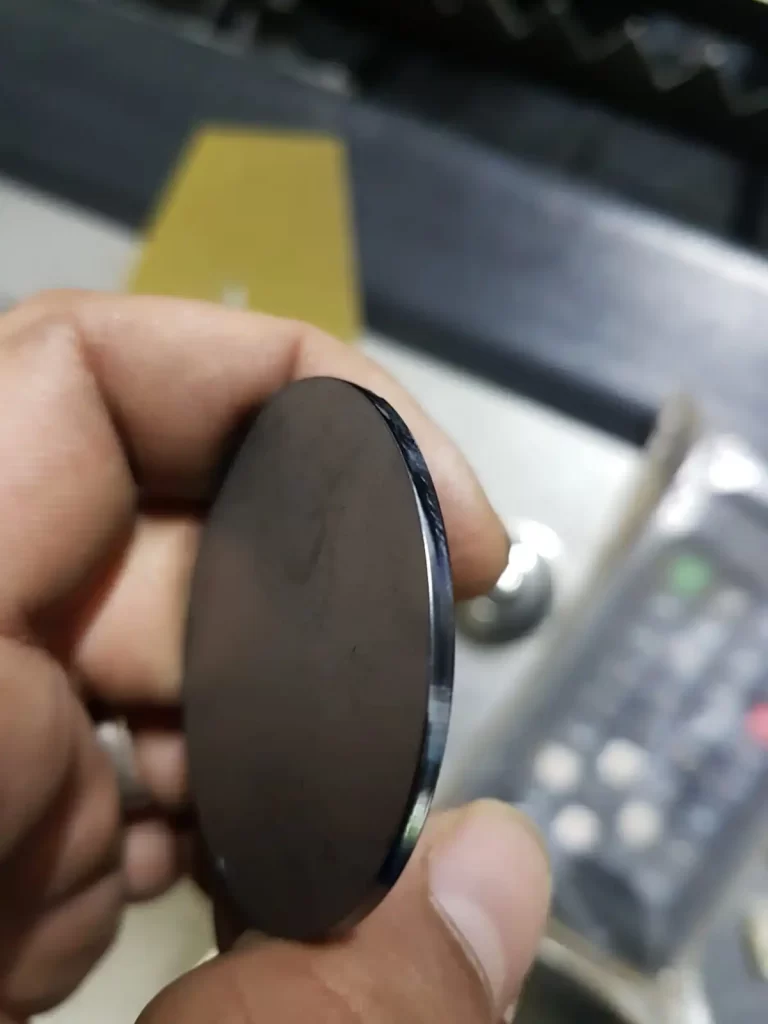
What is trade laser cutting?
Trade laser cutting is a form of contract manufacturing: a company without its own laser, or with more work than its machine can handle, outsources the cutting to a workshop. You supply the drawing and, if you wish, the material; we cut the parts and hand them back.
Metals we cut
- Stainless steel – mirror, brushed, gold and coloured sheets
- Mild steel (DKP)
- Galvanised steel
- Aluminium
Who uses trade laser cutting?
- Sign and advertising companies – letter faces, frames, logos and totem parts, delivered unbranded
- Manufacturers – repeat parts for furniture, lighting, lift and machine makers
- Architecture and interiors – patterned panels, screens and decorative parts
- One-off jobs – prototypes, samples and single parts
How trade laser cutting is priced
The price depends on the material and its thickness, the total cutting length, the number of holes and details, the quantity and whether we supply the material. When the same part is cut many times, the set-up time is shared and the unit price falls.
Order steps
- Send your CorelDRAW 18 (CDR) or PDF drawing at 1:1 scale with quantities
- State material and thickness, or bring your own material
- Approve price and lead time
- Collect the parts or have them sent by cargo within Turkey
Laser and CNC in one workshop
Many sign jobs combine metal and acrylic parts. Because our fiber laser and CNC router are in the same workshop in Bağcılar, Istanbul, both parts of a project can be produced together, which saves time and transport.
Why choose a fiber laser for metal parts
A fiber laser concentrates a very fine beam on the sheet, so it cuts small holes, sharp corners and thin lettering accurately. The narrow cut and the small heat-affected zone keep parts flat and edges clean, which reduces finishing work after cutting.
- No tooling or moulds – each part is cut directly from the drawing
- The same file always gives the same part, which suits repeat orders
- Fine details such as small text and logos stay sharp
- Nesting several parts on one sheet reduces material waste
Preparing files for trade laser cutting
Check that every outline is a closed curve, remove duplicate lines and keep the drawing at 1:1 scale. Text must be converted to curves. Write the material, thickness and quantity of each part inside the CDR or PDF file, and mark which parts may be nested together. A clean file shortens preparation time and avoids questions before cutting starts.
Repeat orders
If you order the same parts regularly, we keep your approved files so that later orders are cut from exactly the same drawing. You only need to tell us the quantity and the material.
Frequently asked questions
Can I bring my own sheet?
Yes. You can supply your own material or ask us to source it.
Do you cut single parts?
Yes. We cut single prototypes as well as series production.
Are parts delivered with your logo?
No. Trade work is delivered unbranded.
Which files do you need?
CorelDRAW 18 (CDR) or PDF at 1:1 scale, with material, thickness and quantity noted inside the file.
Related services
Get a fast quote for your project
Send your artwork as a CorelDRAW 18 (CDR) or PDF file at 1:1 scale with text converted to curves, and note colours, dimensions, quantity and LED details inside the file.